Overview
Welcome to the Chory Lab! This lab handbook is designed to provide you with important information, guidelines, and advice to help you grow and thrive in our lab. Please read it thoroughly, as it contains essential details about our mission, core values, and adaptive expectations for all lab members. This handbook also contains resources to help you catalyze your research. Our goal is for you to feel supported, empowered, and armed with the necessary tools to make groundbreaking advances in biomedical engineering.
“It is not the strongest of the species that survives, nor the most intelligent. It is the one that is most adaptable to change.”
- Charles Darwin
Introduction and Lab Culture
Lab Mission
In the Chory Lab, we're dedicated to fostering a welcoming, collaborative, and intellectually stimulating environment for our members that constantly pushes the boundaries of scientific discovery. Our mission is to use cutting-edge research techniques, like continuous evolution, cellular engineering, and robotics, to expand and gain new insights into the "undruggable" space of genetically and epigenetically misregulated diseases. Together, we recognize the immense potential of synthetic biology to bridge the gaps between molecular evolution, epigenetics, and cancer. Our goal is to overcome the limitations hindering the integration of these fields by developing innovative approaches to assess the complexities of protein evolution, population heterogeneity, and gene regulation simultaneously, driving an adaptive synergy among these disciplines. Through our commitment to collaboration, mentorship, and scientific excellence, we strive to make a lasting impact on the research community and contribute to the advancement of human health and well-being, evolving together toward a better future.
Core Lab Values
- Curiosity
Driven by the desire to explore the unknown, we're excited about new and formidable challenges. Our curiosity fuels our passion for learning, discovery, and innovation.
“In the face of overwhelming odds, we’re faced with only one option:
to science the sh*t out of this.”
- Matt Damon, The Martian11Dr. Chory insists that she has been using this phrase since 2010.
- Collaboration and Open Science:
We work together, share ideas, and support each other's growth and success. By collaborating, we can achieve more than we could individually. We're committed to open-sourcing our work and actively disseminating scientific research to foster innovation and maximize impact.
- Growth Mindset
We embrace the idea that our abilities can be developed through dedication, effort, and learning from both successes and failures. We see challenges as opportunities for growth and are open to reevaluating our approaches (Dweck, 2006; Yeager et al., 2019). Carol Dweck: A Summary of Growth and Fixed Mindsets.
- Life-long learning
We embrace the joy of being wrong. We listen to others' perspectives, question our own priors, and are willing to change our minds. We value the intellectual flexibility that comes from being open to "rethinking"(Grant, 2021), unlearning, and a willingness to update what we believe to be true. Think Again by Adam Grant: Summary & Notes – Calvin Rosser
“Thinking like a scientist involves more than just reacting with an open mind. It means being actively open-minded. It requires searching for reasons why we might be wrong—not for reasons why we must be right—and revising our views based on what we learn.”
- Adam Grant, Think Again
- Perspective and Mutual Respect
We are driven by the belief that a range of viewpoints makes for better science and fuels excellence. We value the unique perspectives, backgrounds, and experiences that each lab member brings. We work to create an environment where people are treated with respect and where we learn from and support one another.
- Communication and Transparency
We believe that clear and open communication is essential for a healthy lab environment. We encourage open dialogue, sharing updates, and discussing challenges to promote trust, understanding, and effective collaboration.
- Integrity and Ethical Conduct
We are committed to conducting research with the highest ethical standards, ensuring honesty, transparency, and responsibility in all our work.
- Balance and Well-being
We believe that maintaining a healthy work-life balance is crucial for personal well-being, long-term success, and sustaining enthusiasm for scientific discovery. Prioritizing self-care (and supporting others' efforts to do the same) helps prevent burnout, ensuring you have the stamina and resilience to remain passionate even during challenging times. Experiments will fail, and science can be hard….if it wasn’t, we wouldn’t be doing it.
- Mentorship and Support
We are committed to fostering a supportive environment where mentorship and guidance are paramount. We invest time and effort in nurturing the growth and development of our lab members, recognizing that their success is our success. We help our colleagues when they need it and celebrate their successes.
- Continuous Evolution
We recognize that the scientific landscape is constantly evolving, and we strive to remain flexible and adaptable in our research approach. We are open to learning from our experiences, embracing change, and continually refining our methods to stay at the forefront of our field. We are dedicated to improving ourselves, our research, and our lab environment. We seek and provide feedback constructively and proactively, with the goal of fostering growth and development.
General Lab Expectations
In our lab, we care deeply about creating a supportive and productive work environment that goes hand-in-hand with our core values. We know that each of you has your own unique working style, preferences, and personal commitments. That's why we've set up some general lab expectations to encourage flexibility, teamwork, and professionalism.
Time Management and Work Environment
We don't enforce strict schedules, but we believe that both the lab culture and learning opportunities are amplified by spending quality time in the lab and with your lab mates. We don't actively track vacation time, but we believe in open communication when it comes to taking time off… just make sure to balance your personal and work lives responsibly. For more info, see the Vacation/Time off Policies section below. Our goal is to create an atmosphere where you're excited and motivated by your projects without feeling pressured by the PI.
Punctuality and Commitment
We hope you'll attend all lab meetings to the best of your ability, and communicate in advance if you can’t attend. Being there for your colleagues by participating in discussions and giving feedback is a big part of growing as a scientist, engineer, and person. Please come prepared and engaged for lab activities like presentations, discussions, and training sessions. For more details see the section on lab meetings, below.
Learning and Collaboration
Take charge of your learning and ask questions when you need help. Stay open to feedback. We like to emphasize that asking questions is way more important than simply having the right answers. Work together with your lab mates and share what you know – and remember, eternal learning means there's no such thing as too many, wrong, or bad questions.
Open Science
We embrace open science principles and contribute to spreading scientific knowledge by sharing data, methods, and findings with the broader scientific community. Our lab uses pre-print platforms like BioRxiv to share our research quickly and transparently, promoting collaboration. For more information, see the Publications and Authorship section below.
Safety and Organization
Your safety is our top priority! As such, always stick to safety guidelines, protocols, and EHS standards. Do your best to keep your work area tidy, storing materials and equipment properly when you're not using them. We know everyone has different levels of standards22No comment RE: which of these previously belonged to Dr. Chory: https://twitter.com/chorye/status/..., but make sure your workspace is organized enough not to negatively impact the safety or productivity of yourself or others in the lab. Be especially mindful of shared reagents; return shared items to their designated spots and clean up communal areas after use. For more information see the lab safety and Ordering Policies below.
Community Building
We believe that excellence in science depends on drawing talent from as wide a pool as possible. The fields of science and engineering have generated some of the greatest human achievements in the last century and will be responsible for the continued health and sustainability of humanity. Yet, STEM fields are generally not representative of the general population, nor of those who will feel the greatest impact of their advancements. Widening that pool is thus critical for the future of scientific achievement, for creating the best learning experiences for our students, and for building strongly empathetic communities. We are committed to fostering an environment that not only drives creativity and innovation but also provides opportunities for individuals from all backgrounds to thrive and contribute to the advancement of knowledge.
From a scientific perspective, when a field's questions are set by a narrow focus, problems of national and global importance can be overlooked— heart disease in women (Mirin, 2021), HIV/AIDS in the LGBTQ+ community (Fee & Krieger, 1993), neglected diseases in the global south (Yamey & Torreele, 2002), and diseases of poverty (Horton, 2003), are all well-documented examples of such oversight. We must foster the skills and perspectives of people from dissimilar backgrounds to avoid replicating historical mistakes and to shape a better future of science.
Our lab, and Duke Universityat large, follows the university policies on equal opportunity and nondiscrimination, and we take them seriously. Everyone here is entitled to the same respect and the same opportunities. We're committed to ensuring everyone can succeed in their pursuit of the advancement of biomedical knowledge. Here's how we're putting that into practice:
- Holistic Recruitment and Retention:We evaluate prospective lab members on the whole picture (Young et al., 2021) of their experiences, drive, and potential. As a mentor, Dr. Chory strives to support and promote trainees at all levels based on their promise and enthusiasm.
- Access to Mentorship and Resources:We're committed to providing equal access to mentorship, resources, and opportunities for all lab members, regardless of their background or prior experiences. Good mentorship is often the difference between a student who finishes and one who does not, and we take that seriously for everyone in the group.
- Open Environment and Dialogue:We’re striving to create an environment where everyone feels welcome and can openly discuss their experiences and challenges. As such, Dr. Chory will be setting up regular check-ins and one-on-one meetings to stay connected.
- Local Outreach and K-12 Engagement:We’re actively looking for opportunities to collaborate with and engage local school districts in Durham and neighboring cities to promote STEM education and offer mentorship opportunities to K-12 students. To learn about opportunities to get involved, visit the Duke Office of Durham and Community website. We also encourage students to engage with the Outreach Design Education (ODE) Programevents such as:
- The Duke Research in Engineering Program (DukeREP) is a 7-week summer program hosted by the BME department for high school students.
- Summer Design Campfor High School Students (June to July)
- Hackathon for Middle School students(end of March)
- Summer Design Camp for Teachers(end of June)
- Working with Local Duke Organizations:We encourage all lab members to participate in the student and professional organizations at Duke, both through BME and the greater university. These are open to anyone who wants to take part:
- Attending Duke BioCoREevents (@DukeBioCoRE).
- Learning from and attending the Duke Next Gen Leaders Fellowssymposium
- The Duke’s Chapters of NSBE, SHPEand SWE.
- Ongoing Evaluation and Improvement:We're constantly looking for ways to do better, and we evaluate and improve how we train and support people, not just in our lab, but in our department, the broader engineering community, and within ourselves.
We’re proud of the work being done by the Duke Pratt school, and particularly the BME department for Duke’s commitment to excellence in engineering education. For more resources, visit the Duke resources for Culture & Belonging.
Harassment Policies
In our laboratory, we have a zero-tolerance policy for harassment, whether it occurs within or outside the lab. We will familiarize ourselves with Duke University's policiesregarding harassment and seek support from each other or other resources when necessary. We expect all lab members to participate in training to develop skills to interrupt and intervene when inappropriate behavior occurs. We also recognize that everyone carries assumptions and blind spots that can affect how we treat each other, and we will take steps to notice and correct them (Godsil et al., 2014; Johnson et al., 2017).
We encourage lab members to explore and familiarize themselves with these academic studies related to bias and harassment available here: Lab Handbook References
Working Hours, Academic Effort, and Degree Progress
The Chory Lab follows the Duke Graduate Student Union Collective Bargaining Agreement (DGSU CBA). In accordance with Article 12 of the CBA, graduate student employees will not be required to regularly perform more than 40 hours per week of work. This does not prohibit a student from voluntarily spending additional time on academic pursuits related to their degree. It is important to clearly distinguish employment-related work hours from academic effort, as these are treated differently under the CBA.
- Academic effort: includes activities that directly advance degree progress. Examples include thesis research, data analysis, experimental design, reading and synthesizing the literature, writing manuscripts, preparing fellowship or grant applications, qualifying exam preparation, coursework, and presenting research. Academic effort is inherently variable over time and is guided by intellectual goals, milestones, and degree requirements rather than fixed hourly expectations.
- Work hours: as defined under the CBA, include duties that do not directly advance degree progress and are performed in a student’s role as an employee. Some examples include:
- Routine lab management tasks
- Ordering and inventory
- Shared equipment maintenance
- Safety or compliance tasks
- Administrative coordination
These activities fall within the scope of employment and are subject to the 40-hour weekly limitation when considered cumulatively with other required work duties.In our lab, lab management and service tasks are intentionally limited and distributed to avoid interfering with academic progress. If a student feels that non-academic duties are becoming excessive or are impacting their ability to make degree-forward progress, they should raise this promptly so responsibilities can be adjusted.
Expectations around productivity, time commitment, or typical effort in the lab refer to academic research effort, not employment hours. We believe that success in research is not measured by time spent in the lab, but by progress toward clearly defined scientific and training milestones.
Vacation/Time off Policies
In our lab, we prioritize open communication and responsible management of personal and work lives. We understand the importance of taking vacation and "mental health days" to unwind and recharge, and we encourage you to take time when needed.
- Work-life Balance: In our lab, we don't actively track vacation time. Our goal is to create an atmosphere where you're excited and motivated by your projects without feeling pressured by the PI. We encourage you to take time off as needed, but also please familiarize yourself with Duke University's general policies for postdoctoral fellowsand graduate students.
- Vacation and Travel Schedule Submission: To support coordination of lab activities, maintain an accurate shared calendar, and ensure safety and emergency awareness, all lab members are asked to submit vacation and travel schedules, through the: Lab Time-off/Travel Submission Form. This form is used for both planned travel and time off, including single day absences and longer trips.
Dr. Chory is committed to transparency and shares her own travel schedule using the same system. All of her travel is available for view at on her calendar.
- Time Off Reporting
- Reporting Policies: In accordance with Duke University guidance and the Duke Graduate Student Union Collective Bargaining Agreement, all labs are required to maintain basic documentation of PhD student time off in a manner consistent with university and union expectations. As such, the lab tracks sick days, discretionary days, bereavement days, and vacation days in a manner consistent with other members of the research workforce.
- Planning and documentation: Planned time off should be requested at least 14 days in advance when possible, particularly for longer trips. This documentation supports fairness, clarity, and consistency across programs and is not intended to change how the lab operates. Nothing about lab expectations or culture is altered by time-off reporting. Lab members are trusted to manage their time responsibly, take time off when needed, and make steady progress toward their degree. This tracking is administrative and is not used to monitor productivity or enforce rigid schedules.
- Fairness: The lab works intentionally to ensure that time off is handled consistently and fairly across all students. At the same time, flexibility is essential. Exceptions may be made, particularly for international students who require longer travel for visa renewal or infrequent trips home. These situations will be discussed case by case, with the goal of being supportive while maintaining transparency and fairness across the group.
- Graduate students submit vacation, sick time, and extended absences using the Lab time-off and travel form.
- Postdoctoral fellows and staff also submit vacation, sick time, and other leave through Duke@Work, following university policy. Travel dates should also be submitted to the Lab time-off and travel form.
Privacy and Transparency
Information submitted through time-off and travel forms is used solely for planning, coordination, and safety purposes. It is not used to evaluate performance or commitment. Lab members should share only the level of detail they are comfortable providing (e.g., dates and general location).
Well-Being
We believe that well-being is essential for a successful research career, and especially beyond. We actively support keeping our mental, emotional, and physical health in check because and recognize that they’re interconnected. We want to support you in taking care of yourself and maintaining a healthy work-life balance. Here are some tips and resources to help you prioritize your well-being:
- Self-care is key
Make time for things that make you happy, relaxed, and fulfilled. Whether it's a quirky hobby33Disclaimer: The Chory lab neither endorses nor condemns yarn-based graffiti vandalism (i.e. yarn bombing, guerilla knitting): https://www.emmajchory.com/creative-projects, exercise, hanging out with friends, or taking breaks, remember that self-care is a must for long-term success and happiness. Make time for activities that bring joy, relaxation, and fulfillment.
- Lean on others
If you're struggling with stress, anxiety, or other challenges, reach out to lab members, friends, family, or professional resources. Remember, you're not alone, and seeking help shows strength and resilience.
- Maintain a healthy work-life balance
Find the right balance between your professional and personal commitments. Set boundaries, communicate your needs, and prioritize your well-being.
- Staying active44Dr. Chory acknowledges from personal experience that this is easier said than done, and that’s okay too 😉:
Duke has fantastic resources for exercise and fitness, both for employeesand students. The lab slack channels #lab-shindigs and #watercooler are a great way to coordinate group fitness activities and increase lab bonding. Below are some on-campus resources you can utilize:
Wilson Recreation Centerfor exercise and fitness classes (12 min walk from CIEMAS)
Duke Health & Fitness Center(25 min walk from CIEMAS)
- Take advantage of mental health resources
Duke offers mental health resources like Counseling & Psychological Services (CAPS), which provide confidential support for students facing personal or academic challenges. Learn more on their website: https://students.duke.edu/wellness/caps/.
For additional resources, see the Mental Health Resources section of the handbook below.
Communication and Meetings
We believe that building a strong foundation of open, effective communication is essential to create a successful and well-functioning research environment. We utilize various channels and platforms to facilitate discussions and keep everyone in the loop. Here's a quick overview on our communication resources and some tips on how to make the most of them.
Communication
Our lab uses Slack for real-time messaging and collaboration. Dive into relevant channels to stay up-to-date with lab news, share resources, and ask for input from your colleagues. Keep the conversations professional and respectful, but don't hesitate to let your hair down and share your personality, puns, and personal victories in the lab #watercooler and #lab-photos channels (bring on the cat videos!). If you haven’t already, join our lab slack channel using the slack invite linkin the lab portal. Once you're in, head over to the #welcome channel and introduce yourself to the lab!
Meeting Schedules, Feedback & Availability
Subgroup-meetings
In our lab, subgroup meetings are held weekly and are centered around specific research themes. These gatherings are designed to be informal discussions that foster a collaborative environment for sharing insights, progress, and challenges within our various research areas. The meetings rotate between different topics every other week, allowing for a broad coverage of the lab's research interests. Despite the informal nature of these discussions, all participants are expected to come prepared to engage fully. Preparation might include:
- Slides showcasing recent data, hypotheses, or experimental designs.
- Figures that visually represent your results or concepts under discussion.
- Benchling files or other digital lab notebooks detailing your experimental progress and findings.
Being prepared with these or other relevant materials ensures that you can effectively communicate your work, receive constructive feedback, and engage in meaningful scientific discourse with your peers and me. These sessions are a key component of our lab's collaborative spirit, providing a platform for critical thinking, creative problem-solving, and collective advancement towards our research goals.
Important: At the beginning of each semester, all lab members are required to update their weekly availability in the lab portal. This information is used to schedule science office hours at times that are convenient for the majority. Please submit your availability through the weekly availability form in the lab portal.
Open Door Policy
I (Dr. Chory) maintain an open door policy to ensure accessibility for all lab members. If my personal calendar shows I'm not in a meeting, feel free to drop by to discuss any matters.
- 1:1 Meetings: 1:1 meetings are available upon request for anyone needing individual guidance on their project, career goals, or any concerns. To schedule a 1:1, lab members are encouraged to book a 1:1 meeting through the scheduling link provided in the lab portal, ensuring dedicated time for focused discussion.
- Science “Office Hours”: To support our collaborative and educational goals, 2 hours every week are dedicated to 'science office hours'. These hours are set aside for discussions on scientific literature, experimental design, data analysis, or any scientific inquiries. The schedule for these office hours is updated each semester to accommodate everyone's availability.
Lab Meetings and Journal Club
Lab meetings are the heartbeat of our collaborative, knowledge-sharing, and professional development efforts. These regular meetings allow us to discuss progress, tackle challenges, and exchange ideas. Treat these meetings and presentations as invaluable opportunities to sharpen your presentation skills and grow as a researcher. We encourage everyone to actively engage and ask tough and thought-provoking questions, but it's crucial to maintain a respectful and courteous atmosphere. Lab meetings are meant to be a safe space for receiving honest feedback and fostering growth. Remember, sharing both the highs and lows of your research journey is essential, as problem-solving is just as important, if not more valuable than successful experiments. The whole point of getting a PhD is to become an expert problem solver.
Schedule and Format
We hold weekly lab meetings, alternating formats to accommodate both research presentations and journal club discussions. As our lab family grows or shrinks, the frequency may change. Lab meetings and journal club sessions alternate every other week, on Thursday mornings. Journal club sessions involve discussing recent publications and scientific advances, while lab meetings focus on presenting research progress. Check the general lab calendarfor updates, changes, and to keep track of the presentation order. Lab meetings are not held on university holidays.
Presentation Uploads and Organization
To keep a history of your progress, upload your presentations to your respective folder on google drive before each lab meeting. Use the naming convention “YYYY-MM-DD YourName PresentationTopic” to make it easy to stay organized, pass on knowledge to future lab members, and reflect on your progress over time. Presentations should be clear, concise, and well-organized. General recommendations for lab meeting presentation format include:
- One slide about yourself (or a fun fact you’d like to share about any non-science topic).
- Some background info on your research topic
- Quick refresher from the last lab meeting (it’s always good to assume that everyone needs a quick reminder of what you’re doing).
- Progress updates
- Future plans
General Lab Meeting Guidelines:
- Attendance
Lab meetings are vital for open communication, collaboration, and progress-sharing. We expect all lab members to attend each lab meeting, to the best of your ability (schedule conflicts with courses are of course understandable). Please let Dr. Chory know in advance if you can't make it.
- Cancellations
Lab meetings and journal club sessions take place when Dr. Chory is in town, and she does her best to minimize travel disruptions. If a lab meeting or a presenter is unavailable or ill, the schedule will simply be pushed back by one week. This ensures that everyone regularly has the opportunity to present and receive feedback, rather than having to wait for a full rotation through the cycle. The calendar will be updated accordingly to reflect cancellations.
- Active Participation
We love it when everyone actively participates in lab meetings by asking questions, providing feedback, and discussing research challenges. Feel free to respectfully ask questions and initiate discussion throughout. Presenters, don't be shy to encourage questions and discussion from your fellow lab members. Be prepared to clarify or elaborate on any points that may be unclear or require further explanation. Be open to criticism and willing to learn from your experiences. And when giving feedback, remember to be respectful and supportive to your colleagues. Focus on specific areas for improvement and offer suggestions for how to address them.
- Visual Aids
Use clear and concise visual aids to help convey your message. Ensure that your slides are well-organized, easy to read, and visually appealing. When presenting a research article for journal club, include relevant figures and tables from the paper to facilitate discussion. See the Figure Creation section below for additional resources.
Lab Calendar & Department Events
We use a shared lab calendar to keep track of important dates, including meetings, seminars, and social events. Both the Chory Lab and BME-wide event calendars are available in the lab portal.This lab calendar includes details and locations on journal club, lab meeting, thesis defenses, lab celebrations etc. We hope that all lab members will do their best to attend as many lab-wide events as possible. If you would like to add the calendar to your Outlook calendar, follow these instructions: Subscribe to google cal in outlook.pdf.
Adding Events to the Lab Calendar:
We invite you to contribute to the lab calendar. If you come across any event—such as conferences, workshops, guest lectures, or other professional gatherings—that you believe is important for the lab community, please feel free to add it to our shared calendar. Simply create the event and send an invitation to ChoryLab Duke. This action will automatically add the event to the lab calendar, making it visible to all lab members.
Research
Lab Notebooks
Maintaining accurate and well-organized lab notebooks and data deposition is important for ensuring reproducibility, knowledge-transfer, and the integrity of our research. In the Chory Lab, we use a group Benchling account for sharing protocols, plasmid maps, and other important experimental details. We also encourage the development and maintenance of a lab wiki for easy access to essential information and resources (in progress).
- Sign up for Benchling
- Join the Chory Lab Benchling through the Lab Portal
- TO-DO [Guidance on project folder organization, read/write/admin access rights, etc.]
Lab Protocols: We maintain a detailed resource of common lab protocols on Benchling. Protocols on Benchling are regularly updated to reflect current best practices in cloning, cell culture, bacterial protocols, and buffer preparations. It's essential for each lab member to contribute to these updates, ensuring our methods stay at the forefront of scientific accuracy and efficiency.
Reagent Repository
Members are responsible for tracking their stocks, including oligos, glycerol stocks, cell lines, etc in the Chory Lab Reagent Repository. The list must be updated at a minimum of once per quarter, but we recommend updating it in real time as you order oligos, and generate reagents.
Progress Reports
- Why We Do Them: Progress reports are an essential part of your research journey. Reflecting on your accomplishments and the challenges you've encountered offers a means to organize your thoughts and identify the next steps in your project. In essence, these 2-page reports serve as an invaluable tool for guiding your ongoing research. Getting into the habit of writing these reports will make your life easier as you move through your Ph.D. or project. While the process might initially seem daunting, rest assured that it is neither a test nor a competition. It's about self-reflection, progress mapping, and strategic planning. As Ph.D. students are required to provide them to your committee members as you approach your defense, this will significantly facilitate your preparation for these events, and make your life easier in general. Moreover, they can serve as an essential resource when applying for fellowships or grants, updating your resume, and aid in articulating your research effectively to different audiences. To make the process less intimidating and more manageable, we encourage you to follow the format guidance provided below.
- Who Does Them: All members of the lab will provide progress reports, irrespective of career stage. Additionally, undergraduate students will also write up a report every 6 months (1-page), or at the end of their time in the lab. For undergraduate students and master students, a written progress report and 1:1 meeting is required for a research letter of recommendation from Dr. Chory.
- When We Do Them: To ensure you get the most out of this process, we will schedule a meeting once every six months to review your progress report together. These meetings will offer an opportunity for personalized feedback, questions, and guidance moving forward.
- How long should you spend on this?: Though it's important to make these reports comprehensive and well-structured, they shouldn't consume too much of your time. Ideally, spend no more than 1-2 day MAX on these reports every six months. They should be detailed but succinct, professional but not overly time-consuming. The first one will probably take the most time. While it’s tempting to throw them together last minute55Note from Dr. Chory: “I promise you won’t regret this. As much as I'd love to have a photographic memory, I simply don't. I rely on these reports as much as you do - they help me to keep up with the fantastic science that you all are doing. Plus, they serve as a preventative measure for my brain turning into mush! Remember, by the end of your journey, you'll likely be the leading expert in your research area, much more so than me.”, you’ll get more out of the process if you prepare in advance.
- Format Guidance: Aim for a succinct yet comprehensive document coursework, teaching, RCR, grant/fellowship writing, and Mentorship sections. This report should be 2 pages total (standard, single-spaced, 11-12 pt font). Dedicate about 1-1.5 pages to your research.
Use this template as a reference: Chory Lab Progress Report & Individual Development Plan. Please ensure to include all relevant progress, achievements, and responsibilities. You may also add other categories or expand on existing ones as necessary, based on your specific role and responsibilities.
Data Best Practices and Storage
Effective data management is a cornerstone of robust and reproducible scientific research. As outlined in our comprehensive guide on Chory Lab’s Best Practices in Experimental Data Management, it is essential to maintain a structured and systematic approach to data handling. This guide specifically delves into managing lab experiment data in RStudio, with detailed instructions on setting up the environment, organizing data, creating directories for data and figures, and strategies for data processing, summarizing, and visualization.
Importance of Raw Data Storage
Many scientific journals now require the submission of raw data alongside manuscripts. Therefore, it is crucial to save all raw data in a manner that is clear, organized, and easily accessible for future reference. Not only does this practice align with publication requirements, but it also saves considerable time and effort that would otherwise be spent revisiting and reformatting data years later.
Data Storage Recommendations
- Cloud Storage:Utilize reliable cloud storage services like Box or Benchling for saving data. These platforms offer a secure and stable means of storing data that is less susceptible to being lost or damaged.
- Project Folders:Organize experimental data in project folders. This should include all associated code for generating figures. To enhance organization, ensure that code generating figures for multiple experiments automatically creates new, date-stamped folders along with relevant metadata.
- Diagrams and Designs:Store all diagrams, designs, and schematics on Box in appropriately labeled folders (e.g., ChoryLab\Designs\Hardware\Example Project). Include date stamps and version numbers for easy tracking. Design goals and feedback should also be documented in these folders.
Computational Cluster Usage at Duke
For details on how to utilize the computational cluster at Duke University, please refer to the following links. These resources will provide step-by-step guidance on accessing and efficiently using the computational resources available at Duke for data analysis and storage.
- Using Duke Computing Cluster (Chory Lab)
- Duke Official Computing Cluster Resources
Lab Wiki
[In progress] Contribute to the lab wiki by adding new protocols, resources, and information as needed. Keep the wiki organized and up-to-date to facilitate collaboration and information sharing among lab members.
Reading and Following the Scientific Literature
Staying informed about the latest scientific literature is essential for staying at the forefront of our field and guiding the direction of our research. Actively engage with the literature by reading relevant articles, attending seminars and conferences, and discussing new findings with your colleagues. When you find a new paper, please share it!
Sharing and Discussion
Share interesting articles and findings with your colleagues through Slack or other group messaging platforms. To facilitate discussions, please share papers on the #paper-trail slack channel and use threads to discuss specific papers. The lab slack channel #paper-trail is the best way to share and keep up-to-date on exciting papers in our field.
Literature Search
Stay current with the latest research in your field by utilizing literature search tools:
- Using Feedly: Create a Feedly account at https://feedly.com/to follow your favorite journals and receive updates on the latest publications. You can organize the journals into categories for easy browsing and set up keyword alerts for specific topics. To easily get started, download this OPML file (FeedlyRSSfiles.opml) which contains RSS feeds for a number of relevant scientific journals. You can add this to your own account using the Feedly batch import function: available here.
- Creating custom RSS feeds through PubMed: To keep up-to-date on research relevant to your specific interest and research project, set up RSS feeds for specific searches on PubMed. This allows you to receive automatic updates whenever new articles matching your search criteria are published, and you can add your custom RSS feed directly to Feedly. Follow this step-by-step guide for using feedly and creating custom RSS feeds: Subscribe to RSS feeds.pdf
- Publication managers: Choose a publication manager that suits your needs. We recommend ReadCube Papers (https://www.papersapp.com/pricing/) for its ease of use and integration with other tools. A student subscription is $3/month billed annually. If you choose to purchase ReadCube Papers, please submit email your receipts to for reimbursement.
Journal Clubs
Participate in journal clubs, where lab members discuss recent publications and their implications. Be prepared to present and discuss the key findings, methodology, and significance of the selected articles. Journal club meetings are held monthly, and the schedule can be found on the shared lab calendar. Lab members are encouraged to suggest articles for discussion.
Social Media
While all social media platforms have their own problems, we believe that open engagement with the scientific community is still a great way to follow papers and build a network. Our lab Twitter account is @ChoryLab. We encourage you to join the science community on Twitter to stay updated on the latest research and to share your achievements and papers with the community at large.
Lab Safety
Safety is a top priority in the Chory Lab. We are committed to maintaining a safe working environment for all lab members and ensuring compliance with all applicable guidelines and regulations. This section provides a general overview of lab safety and compliance practices, as well as resources for further information. Specific emergency item locations and emergency procedures will be provided in supplementary materials. Instructions for how to access Duke Safety Training are available in theLab How-To Guide.
Required Training
All lab members must complete the required safety training before beginning work in the lab. This includes general lab safety, chemical safety, biological safety, and any other relevant training specific to your research area, including:
- Fire/Life Safety (yearly)
- Laboratory Safety – General (yearly)
- Biosafety Level 2 and BBP for Lab Workers (yearly)
- Lab Chemical Waste Management Practices (yearly)
- Hazard Communication for Laboratory Personnel Orientation
- Formaldehyde Exposure Awareness (yearly, your name must be included in the SOP and submitted to OESO) (only if you will be working with formaldehyde)
If your project involves animals, you must complete Duke animal training and any required facility onboarding before starting. See: Duke Animal Safety Training Requirements.
Safety Inspections
The lab undergoes periodic lab inspections conducted by the OESO or internal lab safety representatives. Additional safety instructions can be found here: Lab Safety Documents
Chemical waste & equipment disposal and pickup
Chemical Waste Disposal
Hazardous chemical waste requires scheduling a waste pickup in an appropriate location for hazardous waste storage (flow hoods, etc.). The guidelines for waste disposal and storage can be reviewed here. If you need access to the safety portal to order new barcodes, waste containers, or to submit new pickup requests, follow these Instructions for Submitting Chemical Waste.docx
Equipment Disposal
To dispose of lab equipment, follow these streamlined steps:
- Account Registration:Register with Duke Surplus by visiting their website.
- Decontaminate Equipment:Ensure all equipment is thoroughly decontaminated according to lab safety protocols.
- Complete Disposal Form:Print and complete the Lab Equipment Disposal Form.pdf
- Schedule Pickup:Log in to your Duke Surplus account, report the equipment's location, and arrange for pickup.
Lab Operations
The Chory Lab is committed to maintaining an organized and efficient lab environment. Our lab organization system is designed to ensure smooth operation and easy access to necessary resources for all lab members. Below are key aspects of our lab organization:
Storage Allocation
Individual Storage:
- Refrigerated Space - Individual 4°C and -20°C space in their bay.
- Freezer Space - One rack in the -80°C freezer.
Shared Storage:
- Liquid Nitrogen (LN2) - Shared storage in LN2 for critical samples.
- Common Reagents - Commonly used reagents are stored in shared 4°C and -20°C spaces (both in the main lab and hallway -20C).
- Chemical Storage - A designated chemical storage room is available for storing hazardous and non-hazardous chemicals. A detailed chemical inventory is available in the Lab Safety Documents.
Lab Layout
Chory Lab Layout
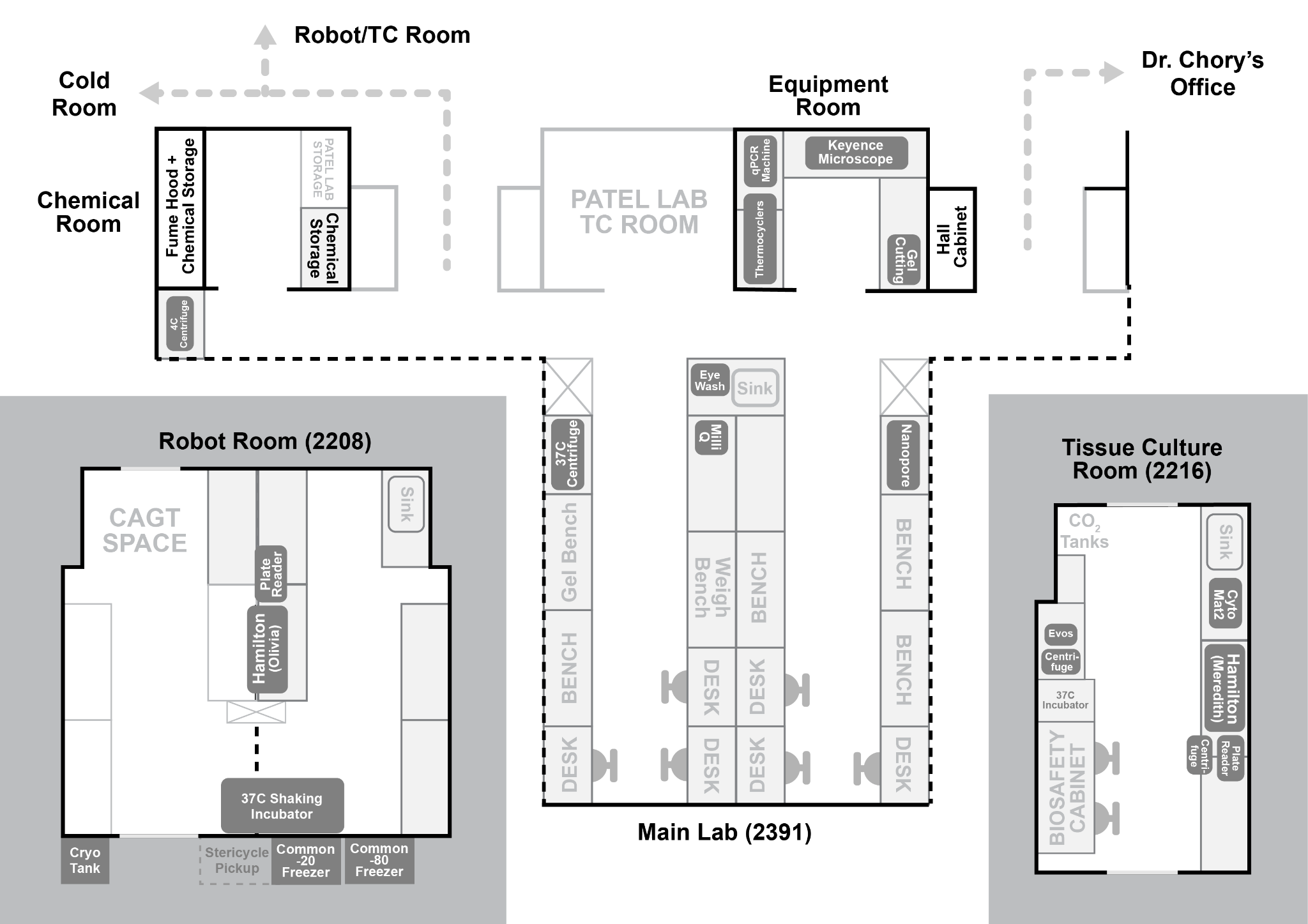
FCIEMAS 2nd Floor Lab Layout
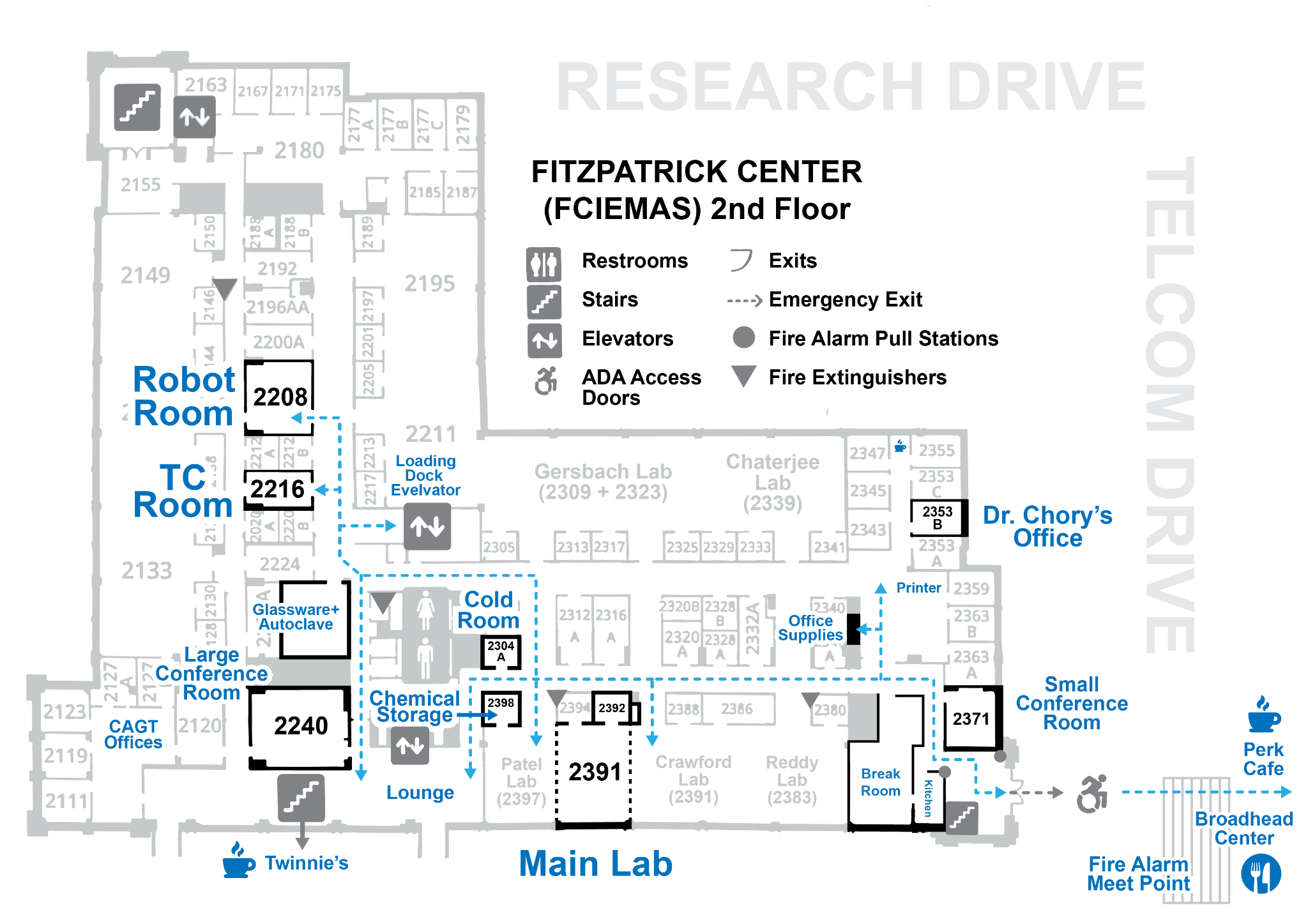
Link to lab maps:https://www.chorylab.com/lab-map
Taskmaster Tasks and Shared Lab Stewardship
To reinforce shared responsibility and signal that we are all in this journey together, the Chory Lab uses a weekly rotating lab operations system called Taskmaster. All lab members, including the PI, rotate through essential operational tasks. Taskmaster is intentionally designed to distribute essential work evenly across all researchers, irrespective of seniority or specialization. Beyond keeping lab operations running smoothly, this system builds shared technical know-how, empathy for the effort required to maintain a research environment, and respect for the contributions each person makes to the collective lab community.
Purpose and Ethos
Taskmaster exists to:
- Make operational labor visible rather than invisible
- Distribute service work evenly across all lab members
- Prevent operational responsibilities from falling disproportionately on any one individual
- Train all members in core lab stewardship and infrastructure
- Build shared ownership of the lab environment
These tasks are not intended to replace or compete with scientific training or degree-forward research. They are deliberately scoped to be finite, transparent, and adjustable as the lab evolves.
Task Assignment and Rotation
Taskmaster duties rotate weekly through all lab members. During a given rotation, tasks are the same across members to ensure fairness and transparency. It is an ongoing goal of the lab to:
- Distribute effort evenly across members
- Align tasks, when possible, with skillsets and project relevance
- Revise task assignments at least biannually to reflect changing lab needs
Expectations and Boundaries
- If you are assigned a Taskmaster duty, you are expected to complete it reliably and in a timely manner to minimize disruptions to lab operations.
- If you are temporarily unavailable (e.g., due to travel or approved time off), it is your responsibility to arrange coverage in advance.
- If Taskmaster responsibilities begin to feel excessive, inefficient, or are interfering with academic or degree-forward progress, this should be raised promptly so that adjustments can be made. Taskmaster is meant to support the lab community while protecting scientific focus and training.
- If you feel like your tasks are requiring too much of your time please reach out and discuss with Dr. Chory so that we can identify better solutions.
Taskmaster Tasks
We operate on an open-lab organization concept which means that when lab items or reagents run low, it is the collective responsibility of all lab members to track and reorder as necessary. Even if it is not your lab job, if something is low, check if it has been has been reordered recenrly.
- Regular Checks: Periodic checks are conducted to ensure that all lab members are adhering to the organization system.
- Updating System: Lab members are encouraged to provide feedback and suggestions for improving the lab organization.
A current list of lab tasks and their descriptions can be found here: Lab Jobs - Support Tasks
The taskmaster list is also available in Bay 1 for the assigned taskmaster to check off items that have been completed and take notes during their duties. The purpose of this strategy of lab management is to provide all lab members with equal exposure to how a lab runs. This aims to provide all lab members with a broad skill set in lab management while also distributing the labor so as to reduce placing the pressure on a single individual.
Ordering Policies
Managing lab supplies efficiently is essential for the smooth operation of the lab. We use the Chory Lab Ordering App, an in-house web app, to place orders, track them through purchasing and receiving, and keep an inventory of what we have in stock. Every order the lab has ever placed lives in the app, so it is also our price history and our catalog. Bookmark the desktop link on your laptop and add the mobile link to your phone home screen.
- Desktop site: Chory Lab Ordering App
- Mobile site: Chory Lab Ordering App (mobile)
Getting access: open the site and sign in with a Google account, then request access. An admin gets a notification and approves you. There is nothing else you need to do.
Ordering is everyone’s job. If something is running low, check the app before assuming someone else has handled it. Search the catalog and the pipeline to see whether it has already been requested, and check the Stock Items tab for the current count.
Before you order: search first
Duplicate orders are the most common and most expensive mistake, so always search before you request.
- Search the Catalog tab. Try the product name, the vendor name, the catalog number (the best match when you have it), and keywords like size, format, or concentration. The catalog shows how many times we have ordered each item, what we last paid, and when.
- Reorder from the catalog when the item is already there. Click the item and use the reorder action. This carries over the vendor, catalog number, pack size, category, and stock link, so nothing has to be retyped and the item does not get duplicated under a slightly different name.
- Check the pipeline. Look at Awaiting Approval, Requested, and Ordered to see whether someone has already put in the request. Requested and Ordered items have not arrived yet.
- Only enter a new item from scratch if it is genuinely not in the catalog.
Placing a new order
Click New Request and fill out the form. Required fields are item name, vendor, catalog number, unit size, unit price, product URL, grant or fund code, type, and subcategory. Some categories ask for a few extra fields, and chemicals also require CAS number, storage temperature, and physical state.
Every item needs its own unique catalog number. The catalog number is how the app tracks an individual item across every order, price, and stock count. If the vendor does not give you one, or you are placing a custom or one-off order, make one up that is specific to that exact item and use the same one every time. Two different products must never share a catalog number, and the same product should never end up under two.
A few things that make this faster:
- Paste the product URL first. For Amazon and eBay links the app pulls in the item name, price, and image automatically, so you rarely have to type them.
- Vendor plus catalog number autofill. If we have ordered the item before, entering the vendor and catalog number fills in the rest from our own history.
- Pack fields. Enter the pack count, the object, and the container (for example 5 x 100 mL bottle) rather than typing a free-text unit size. The app builds the unit size and the per-unit price from these, which is what makes price comparisons across vendors meaningful.
- Quotes and attachments. If you have a quote, attach it to the request.
- Urgent. Flag an order urgent only when it truly blocks work that week.
Orders under $500 go straight to the admins to be placed. Anything over $500 goes to Dr. Chory for approval first. Orders then move Awaiting Approval -> Requested -> Ordered -> Received, and you get a Slack or email notification when yours is placed and when it arrives. You can check any order’s status, PO number, and tracking link on the order itself.
Pricing notes:do not use vendor list prices or online prices to judge whether something is a good deal, because Duke pricing is usually different. The catalog shows what we actually paid last time, and that is the number to compare against. eBay prices are marked with a star and are not treated as a baseline, since they are one-off. For a new item we have not bought before, ask Dr. Chory or the lab manager to check the Buy@Duke price before requesting it.
Templates for large or unusual orders
The app can fill out paperwork we occasionally need, including the Standing PO term sheet and vendor price comparison forms. Most orders never need one. These come up mainly on large purchases, sole-source justifications, and quotes.
If a template is required for what you are requesting, the request form tells you. Otherwise you can open the templates list from the order, fill the form out in the app, and it produces a completed PDF attached to the order. Ask the lab manager if you are not sure whether your order needs one.
Receiving items
When a package arrives, deal with it the same day.
- Check storage requirements and put the item away first. If something has to live at 4 C, -20 C, or -80 C, move it there immediately, even if it is addressed to another lab member. Cold-storage items ask you to confirm the temperature when you mark them received.
- Mark it received in the app. Find the order under the Ordered tab (or search for it) and click Mark Received. This is fastest on your phone. The app records who received it and notifies the requester.
- Record where you put it. Location is required. Pick the location and sublocation so the person who ordered it can find it without asking. On mobile you can also snap a put-away photo, which gets posted with the notification.
- Partial shipments. If only part of the order arrived, enter the quantity you actually received. The order stays in Ordered with a “Partial” badge until the rest shows up.
- Update the stock count for anything we track as stock (see below).
Stock items and reordering
The Stock Items tab tracks the supplies we keep on hand: pipette tips, tubes, gloves, common reagents, and so on. Each stock item has a par level (how many we want to have), a reorder point, and a current in-stock count, and it shows as OK, Low, Out, or Unknown.
- Update the count when you take the last few of something, or whenever you notice the number on the shelf does not match the app. A count nobody updates is worse than no count.
- Reorder when the item hits Low or Out, or when you expect the supply to last less than about two weeks. Use the reorder action on the stock item so the request links back to the same item and preferred vendor instead of creating a new entry.
- Attach a better vendor rather than starting a new item. A stock item can have several catalog entries attached to it, meaning the same product from different vendors, with one marked as the preferred source.
Rating items and leaving notes
This is the most useful thing you can do for everyone else in the lab, and it takes ten seconds.
Any item in the catalog can be rated one to four stars with a note. Rate things you have opinions about, especially the bad ones. If a reagent did not work, the plastic was flimsy, the tips did not seal, the lot was inconsistent, or you ordered the wrong thing and it turned out to be poor quality, leave a star rating and say so in the note. The rating and comment show up in the catalog next to the item, so the next person sees it before they reorder.
The point is to stop the lab from buying the same bad product twice. A one-line note like “these tubes crack at -80, use the other ones” saves someone else a wasted experiment. Positive notes are just as useful: if a cheaper alternative worked fine, say that too.
Standing Purchase Orders (POs)
- What standing POs are for: recurring services only, such as sequencing (for example Azenta or Genewiz), core facilities, laundry, or waste pickup. They may not be used for reagents, consumables, or other physical lab supplies.
- Requesting a new standing PO: submit a normal request in the app and set the type to Standing PO. The form switches to the standing PO fields (vendor, grant, amount, and number of years). You must complete the Standing PO term sheet and attach it to the request. The term sheet template is built into the app, and a copy is in the lab Google Drive: Standing PO Term Sheet.pdf
- Renewals: a new term sheet is not required, but put the existing PO number in the notes on the request so it is renewed against the right PO rather than opened as a new one.
- Checking what already exists: the app lists a vendor’s active standing POs when you select that vendor, and flags any PO expiring within 90 days. Check there before requesting a new one.
Fixing mistakes
If you notice wrong information on an order, such as the wrong category, grant, price, or item name, use the propose-a-change action on the order rather than emailing about it. An admin reviews and applies it, and the correction propagates to the catalog. If an order should not have been placed at all, tell the lab manager so it can be cancelled before it goes into the Duke system. If something in the app is broken or confusing, use the feedback button in the app. It goes straight to the people who can fix it.
Submitting Reimbursements for Lab-Related Expenses
For all lab-related item reimbursements, submit a reimbursement request to the associated admin. This includes software purchases like Geneious where student discounts apply.
Employees/RAs: reimbursements will be processed in concur using your Duke@Work login credentials. Here is a getting started guide for setting up an account.
Non-employee/RA students: for all non-travel lab related reimbursements, use the Student Reimbursement Form. You will need to submit (1) a pdf receipt and (2) award letters if applicable. Allow up to 3 weeks for processing.
- Receipts: Attach clear, legible digital copies of receipts as a single pdf
- Fund code: The fund code for students purchasing lab-related expenses are available in the ordering app.
- Follow-Up: If a reimbursement isn't processed in a timely manner, contact Alice Kessing for an update.
Teaching and Mentorship
Coursework Expectations
As the Chory Lab grows and evolves, we will have students from different departments, backgrounds, and learning styles join us. It’s important to remember that different programs may have unique expectations regarding time devoted to coursework and the types of courses students take, including the amount of time that they may be able to devote to lab. Please recognize that every student's educational needs are different, and each person will set individual expectations for themselves.
As a principal investigator, my primary interest is that students acquire the knowledge and skills necessary to succeed in their PhD. It's important to take your coursework seriously, but remember that the ultimate goal of a PhD is to become a well-rounded researcher and problem solver. Most people will never look at your GPA, so do your best to think of courses as a chance to learn, rather than a source of stress.
When selecting courses, it's important to be thoughtful about timing. Sometimes, it's better to take a programming class when you actually have your own data that you can test it with, as you'll likely get more out of the class. Be mindful of time management between the types of experiments you're conducting and your coursework requirements. Balancing your time effectively will be essential for your success in both the lab and your classes.
Some suggested courses for students in BME include: (See full Recommended Class list here).
- Automation in High-Throughput Biology (BME 590)
- High-dimensional Statistics (STA 915)
- Biology by design (BME 562)
- UPGEN and CMB Modules (Fall, 1 Credit)
We also encourage students to provide feedback on courses they found particularly useful for the lab's interests, and add their comments our Recommended Class list. Over the years, this list will evolve, reflecting the collective experience and knowledge of our lab members. By sharing your insights, you will help future students make more informed decisions about their coursework.
PhD Program Resources
For comprehensive information about Duke BME’s PhD requirements, fellowships, policies, and forms—including travel award guidelines and reimbursement instructions—please refer to the departmental resource folder on Box:
📁 Duke BME PhD Resources Folder
This folder contains:
- Conference Travel Awards and Reimbursement information
- Fellowship databases
- Preliminary exam and dissertation materials
- Degree requirements
- RCR case studies
- Career development resources
Preliminary Exam and Progress Report Meetings
As of September 2026, Duke BME uses digital rubrics for prelim exams and 4th year progress report meetings. You initiate the rubric, and your committee fills it in together.
Where to find the rubric:
- Kuali: search "BME Prelim Rubric" or "BME Progress Report Mtg. Rubric"
- In the exam form email sent to you and Dr. Chory a couple of days before your exam date
- On Canvas: Preliminary Exam, Progress Report Meeting, Final Defense: BME PhD Program
Your steps:
- Complete the first section of the form, enter your committee chair, and submit. The form autofills the initiator, so starting it is on you.
- If you are co-advised, enter your primary advisor or ask both advisors who should be listed.
- Only one form per exam. The committee fills in the rubric together.
- Set your exam date early, then initiate the form as soon as the date is fixed.
- After the committee submits, review the feedback and acknowledge the rubric. You and Dr. Chory each get a copy, and it returns to the department automatically.
Questions or Kuali problems: Helen Richard (Staff Specialist, BME Graduate Programs).
Mentorship
Mentorship is a crucial aspect of our lab culture, and we are committed to fostering a supportive environment where guidance and advice are valued. Actively engage in mentorship opportunities, both as a mentor and a mentee, to promote personal and professional growth for yourself and others.
Mentoring Relationships
Seek guidance from more experienced lab members, including your PI, postdocs, and senior graduate students. Offer your expertise and support to junior lab members and help them navigate their research projects and academic careers.
Regular Check-ins
Schedule regular check-ins with your mentor or mentee to discuss progress, challenges, and goals. Use these meetings as an opportunity to offer feedback, advice, and encouragement. Make sure to schedule regular one-on-one meetings with Dr. Chory to discuss your projects, goals, and any concerns you might have. For ease of scheduling, please use the 1:1 Lab meeting schedulerin the lab portal.
Mentoring Rotation Students and Undergraduates
Taking on rotation students or undergraduate mentees is highly encouraged, as it offers valuable opportunities for both mentors and mentees to learn and grow. However, it is essential to approach mentorship thoughtfully and acknowledge the significant time commitment involved. When mentoring rotation students or undergraduates, consider the following guidelines, and discuss with Dr. Chory.
- Plan Projects Carefully
Ensure that the project is well-thought-out and offers mentees a balance of guidance and independence. Projects that are too unstructured can be discouraging, while overly rigid projects may limit growth.
- Teach Skills Gradually
Encourage students to develop their skills by providing hands-on experience, starting with basic techniques and gradually allowing them to take on more complex tasks.
- Foster Independence
Once students have gained proficiency in specific skills, encourage them to apply these skills independently and take ownership of their work.
- Prioritize Mentorship
Recognize that mentoring is a significant time commitment and be prepared to invest the necessary effort into supporting your mentee's growth and success. Take your mentoring responsibilities seriously and prioritize regular check-ins and communication.
Teaching Expectations
As a member of the Chory Lab, you may have responsibilities as a teaching assistant or guest lecturer. Prepare diligently for your teaching assignments, seek feedback from students, and continually improve your teaching skills. Be available to students for questions, create a positive learning environment, and adhere to grading guidelines and academic policies.
Balancing TA responsibilities with research and coursework can be challenging, so prioritize tasks and avoid becoming overwhelmed. Attend the TA training seminar and explore additional resources to enhance your teaching skills, which will benefit you in and outside of the classroom and lab.
Developing your teaching skills is not only valuable for your current position but also contributes to your long-term growth as a researcher and professional. We encourage you to explore the following teaching topics and incorporate them into your teaching practice:
- Active learning strategies
Active learning techniques (Felder and Brent (2016) Active Learning.pdf) engage students in the learning process, encouraging them to think, analyze, and apply their knowledge. Example: Implement think-pair-share activities, where students first think about a question individually, then discuss their thoughts with a partner, and finally share their insights with the entire class.
- Scaffolded teaching
Scaffolded Teaching.pdf involves breaking down complex concepts (KTCP) or tasks into smaller, more manageable parts, and gradually removing support as students gain mastery. Example: When teaching a new lab technique, first demonstrate the procedure, then guide students through each step, and finally allow them to perform the technique independently.
- Teaching that reaches every student
Good teaching creates a learning environment that is respectful, accessible, and welcoming for every student, regardless of their background or learning preferences. Example: Provide multiple ways for students to engage with and demonstrate their understanding of course material, such as offering both written and oral assessments.
Tanner (2013) Student Engagement and Classroom Equity.pdf
- Building student connection
These interventions focus on fostering a sense of belonging and connectedness among students, which can lead to improved well-being and academic outcomes. Example: At the beginning of the semester, facilitate icebreaker activities that encourage students to share their backgrounds, interests, and experiences, and promote a sense of community within the class.
- Additional Teaching Resources:
- Teaching through (Wiggins & McTighe, 2005)
- Maintaining a growth mindset in teaching improves achievement gaps in learningCanning (2019) Racial Achievement Gaps in STEM.pdf
Publications and Authorship
Collaborative Writing
We're big fans of Google Docs for collaborative writing in our lab. It offers several advantages:
- Simultaneous editing: Google Docs lets multiple authors work on the same document simultaneously, offering real-time updates.
- Version control and efficiency: The platform eliminates the need for sending drafts back and forth, making the writing process more efficient and streamlined.
- Ease of sharing: Share the Google Doc with all relevant lab members and give them appropriate editing or commenting access. This allows everyone to contribute to the paper and provide feedback seamlessly.
- Feedback: When you’re ready for external feedback (collaborators, friends, mentors etc), Google Docs also enables you to share your work with non-author colleagues who can offer valuable insights and comments. We highly encourage this practice.
To help build academic skills we encourage the first author to start the draft of a manuscript and share it with co-authors when you feel comfortable. Dr. Chory is always willing to provide guidance and feedback at any point throughout the writing process.
Reference Management
Paperpile is a fantastic reference management tool that integrates smoothly with Google Docs, making it easy to add and manage citations while writing the manuscript. Here's how to get started:
- Sign up for a Paperpile account at https://paperpile.com.
- Install the Paperpile extension for Google Chrome and log in.
- To insert a reference in a Google Doc, hit “command + shift + p”, search for the desired reference, and insert it into the document. For more instructions, visit this link.
Figure Creation
We recommend Adobe Illustrator for creating professional-quality figures. Illustrator, which is part of the Adobe Creative Cloud suite, offers a wide range of tools and features to design, edit, and format figures to meet journal requirements. As a Duke University lab member, you can access Adobe Creative Cloud at no additional cost.
Download and install Adobe Creative Cloud from Duke OIT using this link.
Manuscript Writing
So, it’s time to write a paper…. Take a deep breath. Promise it’s not as stressful as it seems.
We're committed to producing top-notch research and sharing our findings through scientific publications. Writing a manuscript can be a bit of a maze, with multiple stages and collaborators (both in and outside the lab). So, we've put together this overview of the writing process and some guidelines for determining authorship. We've also included a few tools and resources that we think will make the journey a whole lot smoother.
Here are some steps you can follow during the manuscript writing process:
- Planning: Team up with Dr. Chory and other lab members to discuss the structure and content of the manuscript, including key findings, figures, and tables. When starting to draft a paper, some people (Dr. Chory) find that starting with a figure plan is a great way to guide your paper's layout and content. A figure plan can either be a list of topics with a description, or a physical layout, like a storyboard66What your story board should not look like.. This will help create a logical flow and clear presentation of the research findings. A figure plan should help you to identify gaps, and narrow down essential missing experiments in any story.
- Drafting: Write the first draft of the manuscript, including the introduction, methods, results, and discussion sections. The PI and other lab members will be there to provide feedback and guidance throughout the drafting process.
- Editing: Revise the manuscript based on feedback from the PI and other lab members. This stage might involve multiple rounds of revision and editing to make sure the manuscript is clear, concise, and well-organized.
- External review (optional, but encouraged): If you feel comfortable, share your near-finished draft with friends and colleagues that can provide support and constructive criticism. Use Google Docs to share a single link, such that all suggestions and comments can be incorporated in real-time, which eliminates redundancy.
- Internal review: Share the final draft with the entire lab for an internal review, giving lab members a chance to provide additional feedback and suggestions for improvement.
- Pre-print submission: Submitting your manuscript to BioRxivplays important parts in the modern research era. A pre-print allows the scientific community to access your findings before the final publication and can lead to valuable feedback. Spreading the word about your pre-print on Twitter by creating a tweetorial to highlight the key findings and relevance of your paper, can increase the visibility and impact of your work, and also help with getting early feedback before revisions. When to release your manuscript as a pre-print can depend on personal preference (i.e., after your manuscript gets sent out for review or, fingers crossed, you get positive reviews back) but we prefer to submit pre-prints around the time of submission.
- Submission:Get the manuscript ready for submission, ensuring that all necessary documents, figures, and supplementary materials are properly formatted and submitted according to the journal's guidelines. It can save you a ton of time to read submission instructions from your target journal’s website ahead of time. A journal may want you to provide raw data like uncropped images (i.e. western blots) or deposit data such as sequencing experiments in repositories before submission. As well, if you need to resubmit, keep in mind many journals are not as strict on specific formatting requirements with first submission. See the Data Deposition and Storage section for tips on how to proactively incorporate this into experiments from Day 1, which will pay off in spades.
- Peer review: Next, you wait. When you get reviews back (this can take months!), address comments and suggestions from peer reviewers and resubmit the revised manuscript as needed. This process can be lengthy and often change the entire narrative of the paper (generally in a good way!). See the Authorship Policies section, for more details on this.
- Publication: Celebrate!!!77For reference, one 50 mL falcon tube ≈ ½ glass of champagne flute.
Authorship Policies
We believe in a generous authorship policy, recognizing the importance of supporting all contributors to the research project. We use the Contributor Roles Taxonomy (CRediT)system to acknowledge authorship contributions transparently. The CRediT system categorizes contributions into 14 different roles, such as conceptualization, methodology, data collection, and writing.
Authorship might not be top of mind in the early stages of a project, but as things progress and take shape, it's essential to maintain open communication about authorship expectations and contributions. As manuscripts take shape, it’s important to establish clear expectations but to also acknowledge the fluidity of contributions and circumstances that may affect authorship status.
To promote transparency and prevent disputes, consider the following guidelines:
- Review authorship expectations and contributions when significant changes occur in the project's scope, direction, duration, or team composition.
- Encourage open and honest communication about authorship concerns or disagreements, addressing them promptly and fairly.
Determining authorship order
The final order of authors is decided at submission based on cumulative contributions, time devoted, and professional factors. We encourage collaboration and open discussion of ideas without the presumption of authorship. Decisions will be made based on merit and the overall contribution to the project. Keep in mind that leaving the lab before any paper is completed (due to graduation, job offers, etc.) can change authorship because revisions can take a considerable amount of time, and it's essential to balance the career impact of all involved.
We understand that authorship can be a sensitive topic, and it's important to approach it with empathy and an open mind, ensuring credit is given where it's due, without undermining contributions. Sometimes, changes to authorship order, such as introducing co-first authors, can benefit both parties by allowing shared responsibility and collaborative recognition. Here, clear communication and agreement among all individuals is crucial. To help illustrate the importance of maintaining an open mind about the fluid nature of authorship, here are a few examples:
- The "Passing the Baton" scenario: Imagine Student A starts a project, works on it for two years, and then graduates. Student B picks it up and needs three more years to complete the work. It's like a research relay race where both students have run their laps, and the project crosses the finish line thanks to their combined efforts. In this case, it's crucial to acknowledge and fairly attribute authorship to both students. However, when a student leaves the lab and doesn't continue working on the project, they naturally relinquish control over its direction. This is perfectly fine and sometimes passing the baton is the best career option for all involved.
- The "Plot Twist" scenario: Sometimes, a research project might need extensive revisions or a new discovery might change the course of the story entirely. Picture your project as an adventure where an unexpected twist takes the story in a completely different direction. In such cases, it's important to reevaluate authorship based on the contributions made after the "plot twist" occurred.
- The "Synergy" scenario: In many projects, computational and experimental scientists work together, combining their unique expertise. Think of this as two experts with complementary skills joining forces to tackle a complex problem, where the combined effect of their skills creates something greater than the sum of its parts. Since their skills may not overlap, it's important for these collaborators to exhibit extra empathy and understanding, as they might not have a full grasp of the details of the work or time that went into both the technical and intellectual contributions of the other person. Open communication and mutual respect are crucial to acknowledging each person's efforts fairly when determining authorship.
- The "Partner-in-crime" scenario: If you're fortunate, you might discover a teammate with whom you sync seamlessly from day one, forming the ideal research partnership. In these scenarios, co-first authorship might fit like a glove, with both parties benefiting from shared responsibility and recognition. However, co-first authorship can also present challenges, such as determining the appropriate order of authors or addressing potential disagreements. To navigate these challenges, it's crucial to maintain open communication and reach a mutual agreement among all involved.
Professional Development and Fellowships
Securing fellowships is a great way to support your research, and professional development, and applying for fellowships is highly encouraged. Be proactive in identifying funding opportunities and preparing high-quality proposals that clearly communicate the significance and potential impact of your research. Regularly search for grant and fellowship opportunities relevant to your research and career stage. Use resources such as grants.gov, foundation websites, and university resources to identify potential funding sources.
Example Funding Opportunities for Graduate Students
Internal Funding Opportunities:
- CBTE T32 Fellowship
- Lews Fellowship for International Students
- Pratt School of Engineering Fellowships(Examples: Sloan Scholarship, Dean’s Graduate Fellowships)
Internal Funding Opportunities:
- Johns Hopkins repository of graduate fellowships
- NIH F31
- Travel awards, see the Conferences and Travel section below
For a comprehensive and up-to date list of PhD fellowship opportunities: visit this link.
Example Funding Opportunities for Postdoctoral Fellows
Internal Funding Opportunities:
- CAGT
- Foerster-Bernstein Postdoctoral Fellowship
- Pilot funding grants for small projects
Internal Funding Opportunities:
For a comprehensive and up-to date list of PhD fellowship opportunities: visit this link.
Tips for Applying to Fellowships:
- Start early: Give yourself ample time to research, write, and revise your application.
- Seek advice: Consult with Dr. Chory, mentors, and colleagues who have successfully secured fellowships for guidance on preparing a competitive proposal.
- Tailor your application: Customize your application materials to fit the specific requirements and goals of the funding agency. Make sure to dedicate enough time to understanding the components and requirements of each fellowship in advance
- Letters of recommendation: Most fellowships require multiple letters of recommendation. As a professor, writing a strong, personalized, and heartfelt letter of recommendation is one of the most important things we do for our students. We take this responsibility seriously and want to ensure we do justice to each student's individuality and character. Therefore, it's crucial to communicate your intention to apply for a fellowship at least one month in advance (if not more) to all your letter writers, including Dr. Chory. This allows us the time and space to craft thoughtful letters that capture the essence of who you are as a person and a scientist, and why you deserve the opportunities that the fellowship can provide.
Conferences & Professional Travel Guidelines
Conference Policies
Attending conferences and other scientific meetings is important for networking, staying informed about the latest research, and presenting your own work. We believe that conferences are excellent opportunities for trainees to build networks and learn science. As students progress through their PhD, conference attendance and presenting become increasingly beneficial for professional reasons. Therefore, in years 3 and beyond, conference attendance and presenting is encouraged. For details on paying for/booking travel and reimbursement, see the Reimbursement Guidelines section below.
The lab will typically support up to one domestic conference per trainee per year after the preliminary exam, when the trainee is presenting (poster or talk), consistent with Duke BME travel award guidelines and subject to budget and PI approval. Additional conferences, international travel, or attendance without presenting may be supported case-by-case, or using fellowship funds if available.
Conference Attendance Guidelines:
- Presenting at a conference:Students are generally encouraged to attend one domestic conference per year if they are presenting their research.
- Attending without presenting:If a student wishes to attend a conference without presenting, they should submit a one-page justification explaining why the conference is particularly beneficial for their research and professional development. Approval will be determined on a case-by-case basis.
- Using fellowship funds:If a student receives fellowship funding (e.g., F31 institutional allowance), they are free to spend that money on the conference(s) of their choice, subject to any restrictions imposed by the funding agency.
Additional Guidelines for PhD Students (Including BMES and Duke-Specific Awards)
PhD students are encouraged to apply for multiple sources of travel support and may stack the following awards, provided they meet the eligibility criteria:
- BMES Student Travel Award
- Amount - $500
- Eligibility - Students presenting at the BMES Annual Meeting
- Frequency - Once per year, based on the BMES application process (after prelim).
- BME Department Conference Travel Award
- Before Preliminary Exam - One-time award of $1000. May only be used once during your time as a PhD student
- After Preliminary Exam - Up to two separate awards of $500 each. These may be used for two different conferences in different years or combined with other sources of support for a singleevent
- Application link - BME Travel Award Application
- Approval - Advisor approval email must be sent to Danielle Giles, before funds are approved
- Duke Graduate School Conference Travel Award
- Amount - Up to $525 for domestic or $700 for international conferences
- Eligibility - Students must have passed all parts of the preliminary exam and be presenting a paper or poster
- Frequency - One award per fiscal year (July 1–June 30) after prelim
- Deadline - Apply at least 30 days before the conference start date
- More info -Graduate School Conference Support
We will remind students about these opportunities over the summer when we begin issuing internal lab award letters. You can also find instructions and forms in the Box folder:
Conference Travel & Reimbursements Folder
Local Conferences/Symposiums at Duke:
- Annual Duke BME Retreat
- Annual Qbio Symposium
- AnnualMid-Atlantic Synthetic Biology Symposium
- Regular Duke Seminars are available on theBME Calendar
- Next Gen Leaders Symposium
Conferences/Symposiums commonly attended by our lab:
- Biomedical Engineering Society (BMES)
- Mammalian synthetic biology workshop (MSBW)
- Synthetic biology Engineering, Evolution, and Design (SEED)
- Society for Laboratory Automation and Screening conference (SLAS)
- Gordon Conferences (Synthetic Biology; Chromatin Structure & Function)
Guidelines for Undergraduate Researchers
BMES ( Biomedical Engineering Society Annual Meeting) is the most useful meeting for seniors, since alongside the science it functions much like a graduate school career fair, and it is the meeting the lab expects to support at the undergraduate level. All lab support described here is contingent on available lab travel funding and is applied the same way across all undergraduates. If funding is limited in a given year and the lab cannot support undergraduate travel, that change applies to everyone at once rather than case by case. The goal of these guidelines is a policy that is fair for all students.
- Who is eligible: To apply for lab support as a presenting undergraduate, you must be a senior or rising senior, a Pratt Fellow, or have done research in the lab full time for at least two months (for example, as a summer student). Undergraduates outside these categories are welcome to attend conferences, but lab travel support is reserved for students at these stages, or contingent on special circumstances.
- Requesting support: Email Dr. Chory a one-page justification explaining why the conference is valuable for your research and professional development, along with the abstract you plan to submit, before the conference abstract deadline. Submitting an abstract is encouraged either way; the justification is what the funding decision is based on.
- What the lab covers: If there is a fee to submit an abstract, the lab will cover abstract or poster submission fees, whether or not the abstract is ultimately accepted. Travel and lodging should be funded first through department and university travel awards, and eligible students are expected to apply for them. If your abstract is accepted: The lab will help cover travel and lodging costs that are not met by department or university awards. If your abstract is not accepted: We will decide together before the registration deadline, based on how your project has come together and who else from the lab is attending this particular conference.
- Reimbursement: Follow the same process as all other lab travel and submit through the Lab Reimbursement Portal. See Reimbursement Guidelines below.
- Outside funding: Undergraduates are expected to apply for university travel grants from Pratt or Trinity (Arts & Sciences) and other university conference funding, as well as any department or conference travel awards they are eligible for.
- Lab retreat: In some years the lab retreat is scheduled around a conference that several lab members are already attending. When that is the case, undergraduates are welcome to join and it can be a good alternative travel and networking opportunity. Because retreats often conflict with the course schedule, attendance is handled case by case.
Reimbursement Guidelines88Adapted from Gersbach Lab Travel Policies.
All travel and conference or symposium attendance must be approved in advance by Dr. Chory. Approval must be in writing and attached to the reimbursement documentation, whether the expense is charged to a p card or reimbursed out of pocket.
Important:Per Duke policy, travel reimbursements, including conference registration, cannot be submitted until after travel is completed. You must save all receipts and always request itemized receipts and invoices. Failure to provide required documentation may delay or prevent reimbursement.
Reimbursable Travel Expenses and Requirements
- Airfare
- Only coach or economy class airfare will be reimbursed for domestic or international travel
- Travelers must use U.S. flag air carriers when required
- Coach class refers to the lowest fare offered, sometimes labeled economy, tourist, or single class
- Upgrades beyond coach class are personal expenses and must be purchased separately
- Upgrade charges must appear on a separate receipt from the coach airfare
- Conference or Symposium Registration: Registration receipts must clearly show:
- Conference name
- Location
- Dates
- Proof of payment
- Lodging
- Travelers are encouraged to share hotel rooms when multiple lab members attend the same conference
- Lodging must be moderately priced
- Exceptions may be allowed if the hotel is the official conference venue recommendation with a reserved room block
- You must submit the final hotel receipt, not the booking confirmation
- The final receipt must include taxes and incidentals
- Combined Business and Personal Travel
- If travel is extended, routed indirectly, or interrupted for personal reasons, all additional costs are the responsibility of the traveler. Only expenses incurred during the official conference dates are eligible for reimbursement.
- When airfare is affected by personal travel (for example, arriving early or departing late), the traveler must provide documentation of the comparable airfare for travel beginning and ending on the official conference dates. This documentation must reflect the cost of a standard itinerary at the time of purchase, such as a dated screenshot from Google Flights or a comparable airfare search.
- Reimbursement for airfare in these cases cannot exceed the cost of travel departing on or immediately after the final day of the conference. Any amount above the documented comparable airfare will be considered a personal expense and will not be reimbursed.
- Failure to provide comparable airfare documentation will result in loss of reimbursement for the airfare expense.
- Spouse or Companion Travel
Reimbursement for spousal or companion travel is not permitted. Any related expenses must be excluded from the reimbursement request.
- Meals and Food Expenses
- Itemized receipts are required for all meals
- Meals should be for the traveler only whenever possible, as group meals may be flagged as social expenses during audit
If a tip appears on a non itemized receipt, the itemized receipt must also be included
- Alcohol Policy
- Alcohol is never reimbursable
- Always request a separate receipt if alcohol is ordered
- If alcohol appears on a food receipt, the entire receipt is non reimbursable
- Meals containing alcohol on federal grants must be coded as entertainment or social expenses and are not allowed
- TravelInsurance:
Normally insurance is not an allowable charge, but exceptions can be made (during covid, etc). Please check with Alice or Amberly before purchasing insurance.
- Mileage Reimbursement
- If renting a car, please check the current Duke mileage reimbursement rateto make sure you have the most up-to-date amount. If you plan to rent a car, please check on the requirements with Alice or Amberly before renting.
- Provide a google map showing distance of the start and finish of the trip.
- Gas station receipts are not reimbursable.
- Taxi, Uber, Lyft, and Similar Services
Ground transportation is reimbursable for travel:
- Between home or work and the airport
- Between the airport and the conference hotel
- Between the hotel and conference venue
- Receipts must show payment method and start and end locations
Submitting Travel Receipts for Reimbursement
Before traveling, review the complete Travel Reimbursement Instructions.
All lab members must organize all travel reimbursement materials in the lab Google Drive Travel Reimbursements folder. This folder is the required source of record for all travel documentation.
For each conference, all lab members must do the following:
- Create a folder under Lab Member Travel Reimbursement → Your Full Name
Name the folder: “YYYY ConferenceName”. - Upload each receipt as a separate file into the conference folder. Receipt details will automatically populate in a Travel Receipt Log for each conference.
- After all receipts are uploaded and processed (this is done automatically) complete outstanding details in the the Travel Receipt Log, including trip details, fund codes, and travel awards.
Students (Undergrad, PhD, M.S.)
- Submit all documentation to the Chory Lab Reimbursement Portalonce the Travel Receipt Log and receipts are complete.
- Upload award letters, if applicable
- PhD students must also submit the information from the portal in the PhD Student Reimbursement Form(the lab portal compiles the information for you).
- Please allow up to 3 weeks for reimbursement processing.
Employees, Research Assistants & Post-docs:
- Submit their travel reimbursement through Concurusing Duke@Work credentials
- Attach the required receipts in Concur as part of the expense report
- Here is a getting started guide for setting up an accountin Concur.
Required Travel Receipt Documentation99This documentation is required by the university for submission through the SAP and reimbursement. Please review these requirements before making any purchases for reimbursement.
Airfare Receipt Requirements:
- Receipt must show: Class of airfare & Traveler's Name & Traveler’s Name
- Duke provides reimbursement at the economy/coach fare rate for domestic travel on sponsored research
- If charging to federal grants, must follow the Fly America Act
List of US Airline Codes (http://www.tvlon.com/resources/airlinecodes.htm)
Required supporting documentation for travel reimbursement:
- Itemized receipts: must include vendor name, date/time, amount, itemization, receipts must be legible. If there is a tip, please make sure it is included on the receipt.
- Proposed destination
- Duration of Trip
- Purpose of trip include conference agenda: Snapshot of title page of conference website that includes location and date.
Food Receipt Requirements:
- Itemized receipt: preferably for self only. Group purchases appear as social expense to auditors
- Alcoholic beverages: Cannot be reimbursed on grants and meals that include alcohol are considered a social expense and must be coded as entertainment/social expense.
- Mealtimes for reimbursement:
- Breakfast reimbursement allowed when travel begins prior to a normal breakfast (7am)
- Lunch reimbursement allowed when travel begins before the lunch hour (11am)
- Dinner reimbursement allowed when trip begins prior to the dinner hour (5:30pm or traveler does not get home until after normal dinner hour, 7pm)
Meals on travel come out of the lab's budget. It is the same money that buys reagents, runs the robots, and pays the people in the lab. There is no per diem and no fixed cap: the limit is your judgment. Reasonable claims are reimbursed without any back and forth. If a meal was unusually expensive for a good reason (for example, dinner with a collaborator), provide written justification in your documentation. If this is being abused, Dr. Chory will have a conversation with you about it, and it may affect whether the lab supports your conference travel in future.
Things to do in Durham!
Durham is small enough to get to know quickly and has more going on than it first looks. Two calendars cover most of it: Discover Durhamfor official listings and INDY Weekfor music, film, and everything scrappier. Duke also runs a lot of free programming through Duke Arts. If you are new here, ask at lab meeting, someone has probably already been.
Museums and galleries
- Nasher Museum of ArtFree with a Duke ID, closed Mondays, good cafe.
- 21c Museum HotelRotating contemporary art in a 1937 skyscraper. Galleries are free and open daily.
- Museum of Life and ScienceButterfly conservatory, dinosaur trail, and outdoor exhibits. Still fun without kids.
- Pauli Murray Center for History and Social JusticePauli Murray's childhood home, opened to the public in 2024. Tours Wednesdays and Saturdays, outdoor exhibits free anytime.
- Hayti Heritage CenterBlack arts, film, and history in a restored 1891 church in the historic Hayti district.
- Historic StagvilleOne of the largest sites of plantation slavery in antebellum North Carolina. Grounds free, guided tours $2.
- North Carolina Museum of Art(Raleigh, about 35 minutes). Free permanent collection plus a 164-acre outdoor art park. This is the one people mean by "the Raleigh art museum."
Theatre, music, and performance
- Carolina Theatre of DurhamIndependent film, comedy, and touring acts in a 100-year-old room downtown.
- Durham Performing Arts Center (DPAC)Broadway tours and big-name music and comedy.
- Motorco Music HallMid-size indie shows, with the Parts and Labor bar attached.
- The PinhookSmall, queer-owned, local and touring bands plus dance parties. Cheap cover, great crowd.
- The FruitFormer produce warehouse turned concert, gallery, and performance space.
- Club ERADurham's queer nightclub, in the basement of The Fruit. Drag shows most weekends, 18+.
- Duke ArtsConcerts, dance, and film on campus, often free or heavily discounted for students.
- Cat's Cradle(Carrboro, about 25 minutes). The Triangle's legendary indie venue since 1969.
- Full Frame Documentary Film FestivalFour days of documentaries downtown each spring. Next one is April 1 to 4, 2027.
Sports
- Durham BullsMinor league baseball downtown. Cheap tickets, fireworks nights, and the bull sign from the movie.
- Duke AthleticsBasketball at Cameron is the obvious one, but soccer, baseball, and lacrosse are easy to walk into and usually free or close to it.
Gardens, parks, and swimming
- Sarah P. Duke Gardens55 acres, free, five minutes from lab. Good for a walk while something is incubating.
- Duke Lemur CenterReserve a tour in advance, they do not take walk-ins. Worth doing at least once.
- Duke ForestThousands of acres of trails minutes from campus. Free, no reservation.
- Durham Central ParkFarmers market pavilion, skate park, food trucks, and most downtown outdoor events.
- Eno River State ParkHiking and paddling 10 minutes from downtown, with a new visitor center at Fews Ford.
- Eno QuarryA flooded 1960s quarry ringed by rock, about a mile hike in. Beautiful, but swimming is not officially permitted and there is debris under the surface, so treat it as a hike.
- West Point on the EnoSennett's Hole, a working grist mill, and an easy 2.2 mile loop. Heads up: the park is closed for accessibility construction from July 2026 through January 2027, so check before you drive out.
- American Tobacco Trail22 flat miles of rail trail starting downtown by the ballpark. Best running and biking route in the city.
- Umstead State ParkBigger trail network between Durham and Raleigh, about 25 minutes.
- Jordan LakeSwimming, kayaking, and camping about 40 minutes out.
Weekly regulars: trivia, runs, and game nights
The easiest way to meet people here is to show up to the same thing every week. Most of these are free and none of them require signing up in advance. Schedules do shift, so check before you go. Triangle on the Cheapkeeps a running list of 70+ trivia nights across the Triangle if none of these fit.
- MondayTrivia at Ponysaurus, 6:30pm. Free board game rentals at Moon Dog Meadery(300+ games in the basement under Joe Van Gogh). Trivia at Boxcar Bar and Arcade downtown.
- TuesdayFree trivia at Glass Jug Downtown, 7pm, alternating general knowledge and music. Trivia at DSSOLVR, 7pm.
- WednesdayThe big trivia night in town. Bull McCabe's pub quizat 8:30pm is the classic, free to play, $50 bar tab for first. Bull City Run Clubleaves the downtown store at 6pm with 1, 3, 4, and 6.4 mile routes, all paces welcome. Free board games and vendors at Boxyard RTP, 5:30 to 8:30pm.
- ThursdayThe Pony Run, a social 3 or 5 miler from Ponysauruswith Fleet Feet, check in before 6:30pm and stay for a pint. Trivia at Bull City Ciderworksat 7pm, with a food truck parked out front, and at Durty Bull. Board game night and free rentals at Moon Dog. Karaoke at The Tavern.
- FridayAcoustic open mic at Esmeralda's Cafe, 2nd and 4th Fridays, 6:30 to 10pm, free. Third Fridays bring the art walk plus a night market with 20+ food trucks and live music at Durham Central Park, March through December.
- SaturdayFarmers marketin the morning, karaoke at The Tavernat night, drag and DJs at Club ERAuntil 2am.
- SundayAfternoon trivia at Durty Bull. Several Sundays a year Durham Central Park hosts the Food Truck Rodeo, 50+ trucks, and it is a genuinely big deal here.
Social Stuff
- Triangle Rock Club Durhamfor roped climbing and bouldering.
- The Boulder Garden downtown for bouldering only
- Free public pickleball courtsin five city parks
- Durham Geekson Meetup for board games and tabletop RPGs.
- Discover Durham keeps a listof bars with arcades, shuffleboard, and games.
Coffee, boba, and bakeries
- Oak HouseDowntown Durham. Dr. Chory's Second office.
- Cocoa CinnamonThree locations, house-roasted Little Waves coffee. Order a Dr. Durham.
- MonutsDonuts, bagels, and a full breakfast menu on Broad Street. Go early.
- Beyu CaffeDowntown coffee by day, live jazz and dinner at night. The RTP location has closed, downtown is the one.
- MilklabOrganic boba in the Durham Food Hall.
- Ninth Street BakeryDurham bread institution, good sandwiches, quiet place to write.
- Parker and OtisCoffee, sandwiches, and a gift shop full of things you did not know you needed.
Breweries, wineries, etc
- Bull City Burger and BreweryLocal beef, house beer, and the annual Exotic Meat Month if you are adventurous.
- ZincHouse Winery & BreweryBeautiful winery with music & outdoor seating overlooking the vineyard, about 20 min from downtown.
- Ponysaurus BrewingBig roof deck and beer garden in Golden Belt. Trivia and events most weeks.
- Fullsteam BreweryOne of Durham's first breweries, Southern ingredients, dog and kid friendly.
- Durty Bull BrewingSours and wild ales on Broadway Street.
- Bull City Ciderworks24 cider taps plus NC craft beer downtown. Good option if beer is not your thing.
Food
- Durham Food HallTen-plus vendors under one roof at Liberty Warehouse. Easiest place to feed a group that cannot agree.
- Durham Farmers MarketSaturdays at Durham Central Park, 8am to noon April through November, 9am to noon in winter. Open year round.
- TaTacoOscar Diaz's taqueria on Foster Street, inspired by Mexican mercados and his summers in Jalisco. They nixtamalize and press their own tortillas behind glass in the dining room. Get the tacos, but the mole and the stacked enchiladas are the sleepers.
- MezcalitoTex-Mex on Ramseur Street with a big patio, a long mezcal and margarita list, and a kitchen open until 2am on Fridays and Saturdays.
- Fonda LupitaAlso Mexican, in Brightleaf Square. Generous portions, grad-student prices, birria worth ordering.
- Bull City Burger and BreweryLocal beef, house beer, and the annual Exotic Meat Month if you are adventurous.
- The Mad Hatter's Cafe and BakeshopBrunch and pastry near West Campus, open from 7am daily.
- Pizzeria ToroWood-fired pizza and seasonal snacks, no reservations, but worth the wait.
- Rose's Noodles, Dumplings and SweetsIn Brightleaf. Get the dumplings, then get dessert.
- Boricua SoulPuerto Rican and Southern soul food at American Tobacco Campus. Started as a food truck.
- GuglhupfGerman bakery, cafe, and biergarten. Best patio in town for a slow Sunday.
- Taberna TapasSpanish tapas and wine downtown, good for a long table and easy to split.
- Boxyard RTPShipping-container food hall in RTP with a lawn, games, and free outdoor events. Handy if you are already out at the park.
Special occasions
For a defense, a paper acceptance, a birthday (or visiting family who offered to pay). Durham punches above its weight for Foodies. Four Durham restaurants were named in the first MICHELIN Guide American Southin November 2025. Reserve well ahead for all of these, especially since the guide came out.
- NanasMICHELIN recommendedA Durham institution since 1992, Italian and French classics with local product. Pasta and the chocolate souffle.
- NikosMICHELIN recommendedGreek and Mediterranean meze in a restored tobacco warehouse in Brightleaf. Good for sharing, so the bill splits reasonably.
- Little BullMICHELIN recommendedOscar Diaz's live-fire Mexican-American small plates on North Mangum. The birria dumplings are the thing. Diaz is a two-time James Beard semifinalist and appeared on Top Chef Carolinas in 2026.
- M SushiThe true splurge. Small menu, seafood flown in from Japan, omakase if you are going all in. Book ahead. Got a shoutout from Jerry Seinfeld during commencement in 2025 for how hard it is to get a reservation
Weekend and day trips
- Pilot Mountain State Parkabout 1.5 hoursParking fills early on weekends.
- Hanging Rock State Parkabout 1.75 hoursWaterfalls and a swimming lake.
- North Carolina ZooAsheboro, about 1.5 hoursOne of the largest natural-habitat zoos anywhere, plan on a lot of walking.
- Wrightsville Beachabout 2.5 hoursThe closest good beach, doable in a day, we often have BME retreats here..
- Ashevilleabout 4 hoursBetter as a weekend than a day trip.
- Outer Banksabout 4 hoursWorth the drive at least once.
Annual events worth planning around
- Full Frame Documentary Film FestivalApril.
- Bull City Food and Beer Experiencespring, unlimited tastings across all three floors of DPAC.
- Beaver Queen PageantJune, free, at Duke Park, and gloriously ridiculous.
- Durham's annual events listfor Bimbe, Pride, the Bull City Race Fest, and the rest.
Hard Conversations
Professional Conflicts of Interest
As researchers, we must uphold the highest standards of ethical conduct in our work. This includes identifying and addressing potential conflicts of interest. Conflicts of interest can arise from financial, personal, or professional relationships that may compromise the integrity of our research. We are committed to maintaining transparency and addressing potential conflicts in a proactive and responsible manner.
- Disclosure: If you are involved in any activities or relationships that could potentially create a conflict of interest, such as consulting work or collaborations with industry partners, please disclose this information to Dr. Chory and relevant lab members. Discussions prior to potential conflicts of interest and ongoing transparency is key to addressing and managing conflicts of interest.
- Consulting opportunities: If you are considering a consulting opportunity or collaboration outside of your primary research responsibilities, discuss this with Dr. Chory before making any commitments. We encourage lab members to pursue professional development opportunities, but it is essential to ensure that these activities do not compromise the integrity of our research or the well-being of our lab members.
- Training: Participate in conflict-of-interest training sessions or workshops offered by Duke University. These educational resources will help you identify potential conflicts of interest and provide guidance on managing them effectively.
- Resolving conflicts of interest: If you believe that a conflict of interest has arisen within the lab, or if you are concerned about the potential for a conflict, please bring this to the attention of Dr. Chory. We are committed to addressing concerns promptly, fairly, and with the best interests of our lab members and research in mind.
Conflict Resolution
In the Chory Lab, we recognize that conflicts may arise for various reasons, and we are committed to addressing them proactively and constructively. We understand that we are all human and can make mistakes1010This includes Dr. Chory!. Our goal is to create a transparent environment where lab members can work through conflicts and prevent them from escalating. By following these guidelines, our goal is to create a productive and positive lab environment where conflicts are resolved effectively and amicably.
Here is our approach to conflict resolution:
- Open communication & Collaboration: Encourage open and honest communication among lab members. Share concerns, listen actively, and seek understanding to foster a culture of trust and respect. Work together to find mutually beneficial solutions, focusing on common goals and interests.
- Empathy & Self-reflection: Approach conflicts with empathy, recognizing the emotions and perspectives of all parties involved. Reflect on your actions and communication style, and be open to learning from conflicts to promote personal and professional growth.
- PI involvement: Although we strive to give our students independence, Dr. Chory is always available to support you in addressing conflicts, especially those involving external collaborators, or where you might feel impacted by a power imbalance. Do not hesitate to reach out if you need assistance or guidance.
- Establishing expectations: Our goal is to clearly define roles, responsibilities, and expectations within the lab to minimize misunderstandings. If you feel as though your role is not clearly defined, or your roles and responsibilities need redefining, please do not hesitate to discuss these concerns with Dr. Chory.
- Confidentiality: Treat conflict resolution discussions with confidentiality, respecting the privacy of all parties involved. If you are having a sensitive discussion it is perfectly appropriate to clarify an understanding of confidentiality between participants.
- Support resources: Support for a conflict can be obtained beyond your lab community and Dr. Chory. Utilize Duke University's resources, such as Counseling & Psychological Services (CAPS), to seek support during challenging situations:
- Resources for students:https://caps.studentaffairs.duke.edu/
- Support resources for postdocs/employees:Duke Personal Assistance Service
- Faculty mentors: Your academic advisors (undergrad & grad) and thesis committees serve as another layer of support. These individuals are there to guide you, including during times of conflict. They can provide additional perspectives, help mediate discussions, and lend their experience. Don't hesitate to reach out to them. Their goal, along with ours, is to ensure a positive and productive research environment.
- Mediation: If necessary, involve a neutral third party, such as a department mediator, to help facilitate a resolution:
- TheDuke Ombuds Office: is an accessible and supportive resource providing confidential, impartial guidance to anyone in the Duke community navigating work or study-related challenges. Duke has both student-specific and postdoc-specific ombudspersons, who provide a safe space to discuss concerns, offering confidential assistance for resolving conflicts or addressing potential issues.
- Resources for Students: Duke offers mediation services through the Office of Student Conflict Resolution: https://studentaffairs.duke.edu/conduct/services/conflict-resolution.
- Resources for Post-docs: and provides additional resources for stress reduction and conflict resolution for postdoctoral fellows, which are available at this link:
https://postdoc.duke.edu/conflict-resolution-stress-reduction-and-legal-resources-postdocs
Contemplating Career Changes
Embarking on an academic journey, whether it be as an undergraduate, a PhD student, or a postdoc, is a transformative experience, rich with discovery, challenges, and personal growth. As with any new chapter of your life, it's essential to remember that life is dynamic and situations can change. However, life is dynamic, and changing circumstances or evolving interests might prompt you to reassess your path… and that's okay.
Recognizing that you have passions or priorities that might better align with your personal life, mental health, or career goals, is not a failure. It's a testament to your self-awareness and courage. Whether you are re-evaluating your current position, contemplating a change in labs, or considering leaving your program entirely, we are here to support you.
- If you find yourself re-evaluating your career plan or even Ph.D: It's essential to remember that having different passions or priorities that might better align with your personal life, mental health, or career goals, is not a failure. It's a testament to your self-awareness and courage. Whether you are considering changing labs, leaving your program, or simply exploring new options, start by discussing your personal and professional goals with Dr. Chory, academic advisors, mentors, and trusted peers in the lab, program, or within CAGT. Duke’s professional resources are also available to you. Rest assured, these conversations will be respected and remain confidential.
- Open communication with Dr. Chory: If, after considering your options and seeking advice, you believe a significant change, such as leaving your current program or position, might be the right course of action, please do not hesitate to discuss your feelings, plans, or concerns with Dr. Chory. These discussions aim to ensure you feel heard, supported, and equipped to make an informed decision about what is best for you. Changing your career plan is perfectly okay, as there's no one-size-fits-all path to success.
- Plan Next Steps: Should you decide to make a major change, we will support you through the transition. This could involve helping you find a position that aligns with your career goals, providing references for external job applications, or giving you time and space to plan your next steps.
Remember, success is highly personal and non-linear. Changing your path is not a sign of defeat; it's a courageous step toward personal growth and happiness. No matter what path you take, we will be proud of the work you have done and the unique contributions you will make to our lab. Whatever your future holds, you will always be a valued member of the Chory Lab family.
Additional University Resources
Mental Health Resources
Student mental health and wellness is of primary importance at Duke, and the university offers resources to support students in managing daily stress and self-care. Duke offers several resources for students to seek assistance on coursework and to nurture daily habits that support overall well-being, some of which are listed below:
- The Academic Resource Center: (919) 684-5917, or arc.duke.edu,
- DuWell: (919) 681-8421, or DuWell - Duke Student Affairs. If your mental health concerns and/or stressful events negatively affect your daily emotional state, academic performance, or ability to participate in your daily activities, many resources are available to help you through difficult times. Duke encourages all students to access these resources.
- DukeReach: Provides comprehensive outreach services to identify and support students in managing all aspects of well-being. If you have concerns about a student's behavior or health visit the website for resources and assistance. Duke Student Affairs
- Counseling and Psychological Services (CAPS): CAPS services include individual, group, and couples counseling services, health coaching, psychiatric services, and workshops and discussions. (919) 660-1000. Counseling and Psychological Services (CAPS)
- Blue Devils Care: A convenient and cost-effective way for Duke students to receive 24/7 mental health support through TalkNow and scheduled counseling. bluedevilscare.duke.edu
- Two-Click Support: Duke Student Government and DukeReach partnership that connects students to help in just two clicks. https://bit.ly/TwoClickSupport
References
Canning, E. A., Muenks, K., Green, D. J., & Murphy, M. C. (2019). STEM faculty who believe ability is fixed have larger racial achievement gaps and inspire less student motivation in their classes. Science Advances, 5(2), eaau4734.
Dweck, C. S. (2006). Mindset: The New Psychology of Success. Random House Publishing Group.
Fee, E., & Krieger, N. (1993). Understanding AIDS: Historical Interpretations and the Limits of Biomedical Individualism. Am J Public Health, 1477–1486.
Felder, R. M., & Brent, R. (2016). Teaching and Learning STEM: A Practical Guide. John Wiley & Sons.
Godsil, R. D., Tropp, L. R., Goff, P. A., & Powell, J. A. (2014). Addressing implicit bias, racial anxiety, and stereotype threat in education and health care. The Science of Equality, 1(November), 1–90.
Grant, A. (2021). Think Again: The Power of Knowing what You Don’t Know. Penguin.
Horton, R. (2003). Medical journals: evidence of bias against the diseases of poverty. The Lancet, 361(9359), 712–713.
Johnson, T. J., Ellison, A. M., Dalembert, G., Fowler, J., Dhingra, M., Shaw, K., & Ibrahim, S. (2017). Implicit Bias in Pediatric Academic Medicine. Journal of the National Medical Association, 109(3), 156–163.
Mirin, A. A. (2021). Gender Disparity in the Funding of Diseases by the U.S. National Institutes of Health. Journal of Women’s Health , 30(7), 956–963.
Tanner, K. D. (2013). Structure matters: twenty-one teaching strategies to promote student engagement and cultivate classroom equity. CBE Life Sciences Education, 12(3), 322–331.
Wiggins, G. P., & McTighe, J. (2005). Understanding by Design. ASCD.
Yamey, G., & Torreele, E. (2002). The world’s most neglected diseases. BMJ , 325(7357), 176–177.
Yeager, D. S., Hanselman, P., Walton, G. M., Murray, J. S., Crosnoe, R., Muller, C., Tipton, E., Schneider, B., Hulleman, C. S., Hinojosa, C. P., Paunesku, D., Romero, C., Flint, K., Roberts, A., Trott, J., Iachan, R., Buontempo, J., Yang, S. M., Carvalho, C. M., … Dweck, C. S. (2019). A national experiment reveals where a growth mindset improves achievement. Nature, 573(7774), 364–369.
Young, N. T., Tollefson, K., Zegers, R. G. T., & Caballero, M. D. (2021). Rubric-based holistic review: a promising route to equitable graduate admissions in physics. In arXiv [physics.ed-ph]. arXiv.http://arxiv.org/abs/2110.04329